Description
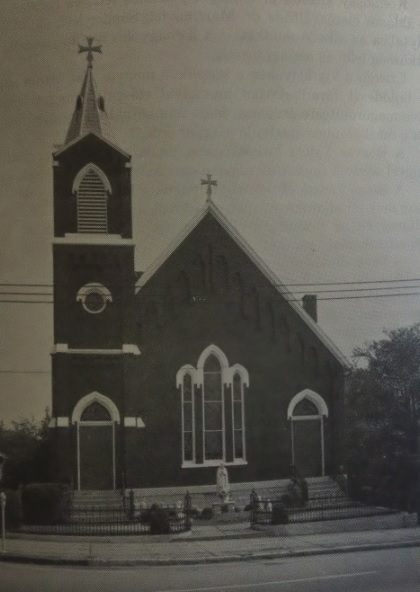
St. László Church in Beaver Falls was one of the smaller but significant ethnic parishes of the Hungarian Catholic immigrant community in the Pittsburgh area. The community developed in the industrial areas of Beaver Falls and New Brighton, where many Hungarian immigrants settled in the early 20th century. According to data from the Diocese of Pittsburgh, the parish was founded in 1923 as a Hungarian ethnic parish, primarily so that the faithful could participate in Catholic services in their native language. The first Mass was held at the Polish Holy Trinity Parish.
According to the uploaded Hungarian text, the spiritual care of the Hungarian Catholics in Beaver Falls–New Brighton was initially provided by other Hungarian priests. Kálmán Kovács, pastor of McKeesport and the Monongahela Valley, took on the care of the Hungarian faithful, and later the Hungarian pastor from nearby Leechburg also visited them. The community first operated as a branch of St. Anne’s Parish in Pittsburgh; after István Nyiri, Dr. Miklós Komlóssy organized it into an independent parish.
A decisive step for the parish occurred in 1924, when the Hungarian parishioners purchased the former First Reformed Presbyterian Church, which had been built in 1878. The church was consecrated as a Catholic church in September 1924 in honor of King Saint László. According to Hungarian accounts, Kálmán Kovács consecrated the building on behalf of the bishop. The community quickly established a parish, and according to the text, acquired real estate worth $60,000 within sixteen months.
The St. László parish included not only Hungarians from Beaver Falls and New Brighton, but also parishioners from Ellport. According to the uploaded text, in 1929 the community’s registry listed five hundred names, and seventy parishioners from Ellport provided financial support to the parish. The names of János Nusser, Kálmán Görcsös, Viktor Gajdó, József Boller, and Sándor Juhász are listed as curators.
The church’s first organizing pastor, Dr. Miklós Komlóssy, later became a pastor in Pittsburgh and died at a young age. His successor was Dr. Sándor Martinovich, who, according to Hungarian sources, continued to manage the spiritual and financial affairs of the parish in an orderly manner. The community did not have its own school, but on Saturdays, Polish nuns taught the Hungarian children. Several religious societies were associated with parish life: the Society of the Holy Name, the Altar Society, the Rosary Society, and the St. Elizabeth Society.
The community’s decline became apparent in the 1950s. According to the Diocese of Pittsburgh, the number of parishioners declined because many people moved away from Beaver Falls. By 1969, the church no longer had a resident pastor and was administered by St. Mary’s Parish in Beaver Falls. By 1985, only 88 parishioners remained, so the diocese deemed it no longer viable to maintain the parish due to the small congregation and a shortage of priests. The St. László Parish was officially dissolved on September 27, 1985.